What do a budding interior designer, a soulful artist, and two out-of-towners have in common? Not much at first sight, but under a very specific set of circumstances, this bunch would find out there’s more than meets the eye. Turns out, when you have prolonged, forced exposure to complete strangers, it’s in fact quite possible for that to change in the course of an evening.
Spontaneous reaction
A long-weekend stay in Austin gave us the chance to check out Birdie’s, a restaurant and wine bar with a highly-recommended wine list, and for good reason. There’s something for everyone, and unlike a typical restaurant wine list, they structure their list beyond the red, white, rosé categorization. They understand that wine is a feeling, and whatever is manifesting in the moment, the wine list guides you to something complementary to create an experience.
Even more unusual is the counter service concept, unexpected from a James Beard award winner, yet delightful in its prix-fixe simplicity that invites you to sit back and enjoy. Well, we waited our turn to order at the counter. A wait that had us standing outside in –thankfully–wonderful spring temps for close to two hours. You’ve got to wonder, is it worth the wait? When Barbera is involved, the answer is “Yes”.
Common threads
It struck me that waiting in line to order was a forcing function for conversation. At some point, you start to look around and observe others. Perhaps catch pieces of conversations happening around you, or give in to curiosity and ask the person in front of you what’s in their wine glass. The budding interior designer in front of us was enjoying a Rosé blend of Grenache and Syrah, when her true heart’s desire was a crisp, citrus-forward Txakoli on her birthday. That was enough spark to jumpstart a conversation about our own experience pairing Txakoli and pintxos while visiting the Spanish Basque Country.
The line advances. Every inch moves us closer to the restaurant entrance and introduces new topics to the conversation. We learn that her partner, a soulful artist devoted to music, looks to the greats of Classic Rock, Motown and R&B for inspiration. The conversation takes a turn toward the philosophical: the source of talent, whether it’s a learned ability or something entirely innate that no amount of practice can replicate. Knowingly pointing to the dramatized example of Mozart and Salieri in the film Amadeus. We reach the counter and unanimously ask the hostess if we could all be seated together.
Young and vibrant Piedmont
Uninterrupted and eager to continue the conversation, we’re seated and begin to study the menu. A nod to Rome and quintessential Italian flavors. Our soulful artist tells us about his experience in Northern Italy, where he was introduced to fine examples of Barolo and Barbaresco. Bold tannins captured in fond memories, giving structure to a broadened view of the world. I was drawn in by his conclusion that the experience changed him for the better. I share the exact sentiment from my own travels.
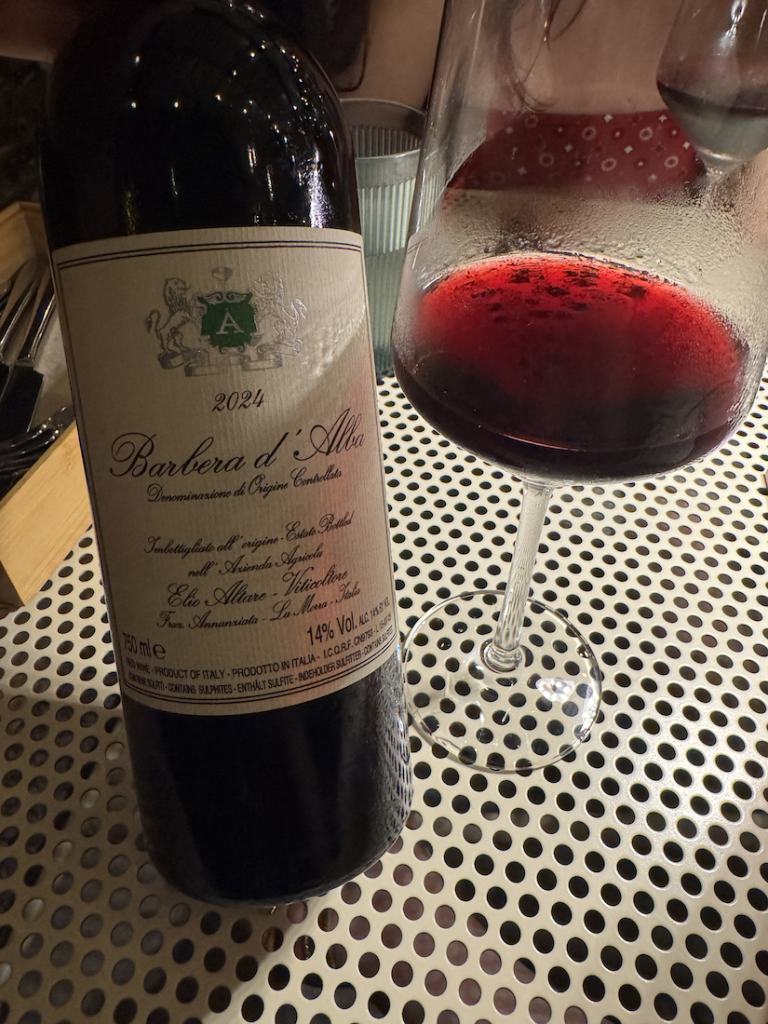
He turns to me and says “pick a bottle”. I go through the list and spot the perfect pairing: Elio Altare, Barbera d’Alba DOC, La Morra, Piedmont, Italy, 2024.
How this looks in the glass: clear with a medium ruby color
On the nose: incredibly aromatic with pronounced floral notes of violet and fresh red fruits, like red cherry, strawberry, red plum. No discernable aromas from oak or spice, which may have been influenced by serving temperature because the bottle was slightly chilled.
On the palate: dry with high acidity, medium tannins, medium body, and medium alcohol. Medium intensity from primary flavors of ripe, red fruits, like red cherry, strawberry, and red plum. Notable flavors of black fruit I did not detect on the nose, such as blueberry and black plum were also present. No secondary flavors from oak or maturation. Long finish from the ripe, red fruits.
Conclusion on drinking potential: this is a very good wine with intense aromas and flavors from ripe fruit that are still detectable in the long finish. The ripe fruit is juicy and can be enjoyed now, even though the high acidity makes it suitable for aging, and will give the wine complexity in aromas and flavors with bottle aging.
Leave a Reply